Figures of speech part 4
Here’s a nice passage from the preface to The Journey of Man by Spencer Wells.
Our DNA carries, hidden in its string of four simple letters, a historical document stretching back to the origin of life and the first self-replicating molecules, through our amoebic ancestors, and down to the present day.
Here we have some nice examples of figurative language in what amounts to a scientific document. It’s in the preface, so the figures are appropriate, I think. Let’s take them out, and you’ll see what I mean.
Human DNA contains, in its string of billions of copies of four nucleotides, information that describes life from the time of its origin until now.
Not nearly as interesting, is it?
The original sentence contains examples of personification (ancestors), pleonasm (“present day” instead of “now”), metonymy (“letters” instead of “nucleotides”), synecdoche (“four” instead of “string of billions of copies of four”), hysteron-proteron (putting “self-replicating molecules” ahead of “the origin of life”), metaphor (“document” instead of “information”), and anabasis (adding “amoebic ancestors” between “molecules” and “present day.”) There; I think I got them all. You might include catachresis, or incongruity, since we generally consider the movement from self-replicating chemicals to humans as moving upward, but he describes the passage of time as downward (“down to the present…”). He also starts describing time as going back to the origin, and ends by coming down to the present. Adding physical directions to the passage of time is a figure of speech, too, but whatcha gonna do?
personification: attributing human characteristics to something
pleonasm: redundancy
metonymy: substituting one noun for another
synecdoche: saying a part of something, but meaning the whole thing
hysteron-proteron: putting the second thing first
metaphor: giving something another name
anabasis: going slowly upward
catachresis: being self-contradictory
Your reaction is probably surprise. To which I say, figures of speech are pretty common, aren’t they?
If you prefer, here’s a simpler approach:

I've seen versions of this used to explain mathematical proofs, too. Sorry, I don't know the source.
Subscribe to this blog's RSS feed
Verbing nouns
In English we have a habit of taking apparent prefixes and suffixes off a word to make a new word. It’s called back formation. So we have an invite when we used to have an invitation. Grammarians tend to disfavor this, but English is littered with these forms, so we curmudgeons may as well learn to live with them.
Another bad habit that is practiced quite a lot is to make a verb out of a noun. For example, “text.” Is it a noun or a verb? Remember the song, “Matchmaker Matchmaker, catch me a catch”? I remember someone once criticizing this habit when we have perfectly good ways to say something already. They were writing about using “office” as a verb, as in “Where do you office?”
I am slightly embarrassed to confess that I joined this club today with my own neologism. First a little context. A geek joke is running around in the texting community, in which instead of (ahem) texting “K” (short for “okay”), the person texts “potassium.” Get it? (Okay, for my non-chemist non-geek readers, the chemical symbol for the element potassium is K. Hence the joke.)
It probably won’t last long because texters are notoriously frugal with their keystrokes, but I like the joke, and I used it on someone the other day. Then I texted a friend who was in on the joke that I had potassiumed someone.
Mea culpa.
Bad attraction
The Writing Rag’s last post made a passing reference to attraction.
Grammatical attraction is when a word picks up a grammatical characteristic from a nearby word. I’m told this is permitted in Latin. However, it is generally frowned upon in English. The exception is when you have a compound phrase that uses “or” as the conjunction, you take the number (singular or plural) from the last word in the phrase. So you have something like “an apple or some grapes are enough to eat before supper, young man.” Or “A few grapes or an apple is enough…” Well-remembered quotes from my mother, long ago. With “and” as the conjunction, it’s always plural, by the way.
But attraction is a no-no when you get the number of a verb from a nearby prepositional object. In English, the subject and the verb must always agree, no matter how far apart they are. And for a quote that forces me to point out this error, from the March 2012 Scientific American, whose writing standards used to be impeccable, but seem to have slipped a bit, especially in their blogs (but I digress):
In Western democracies, consolidation of Internet service providers has put a shrinking number of corporate entities in control of growing shares of Internet traffic, giving companies such as Comcast and AT&T both the incentive and power to speed traffic served by their own media partners at the expense of competitors.
…
A small but dedicated community of digital activists are working on it.
(The “it” in the second sentence does not refer to what’s going on in the first sentence.) Look at the verbs. In the first sentence, they got it right. The subject is “consolidation,” a singular. The verb is “has put,” also singular. Good! They got it right in this long and complicated sentence. But look at the second sentence. The subject is “community,” a singular. And the verb? “Are working.” A plural! How did they get “A community are working?” By attraction to the plural object in the phrase “of digital activists.” I remember Mrs. Clemens in sixth grade warning us to be alert for this goof.
Don’t you make it.
P.S. I ran into this sentence the day after I posted this lesson. Can you find the mistake? I hope it jumps out at you.
An analysis of 1.95 billion cell phone calls and 489 million text messages reveal how men and women follow different relationship patterns during their lifetimes.
And or or or and/or?
I left the punctuation out of the title to get your attention. It should be this: “And” or “or” or “and/or”?
These two conjunctions sometimes give people problems, especially when either word makes sense. So here are a few guidelines.
“And” creates a plural. (The correct name for this kind of plural is compound.) Dick and Jane are siblings. Naturally, we have some exceptions. When a single thing has a compound name, we still use the singular. Research and Development is a new department at our company, which is named Swift & Co.
“Or” takes its number from the last item. Either ham or eggs are fine with me. Either eggs or ham is enough. (Taking a grammatical feature based on the closest item is called attraction, by the way.)
Then we have the ugly formation “and/or.” I read that a town once legislated the word “andor,” but it didn’t catch on. Usually this pseudo-word is a testament to sloppy thinking. Ask yourself, “How much is necessary for this sentence to be true?” If one of the items is sufficient, even if they both can happen then use “or.” Most of the time this is the case. If both things happening is genuinely a third item, then add “or both” to your sentence. Usually I find “and/or” in material written by amateur writers, so my handy example sentences are (ahem) protected by a confidentially agreement, so I’ll try to make something up:
If your tires have bald spots and/or start to hydroplane on wet pavement, it’s time to get new tires.
When the government is corrupt, the people can get restless and/or rebel.
Obviously either condition should be enough to make you start looking for a tire store. “Or” will do just fine. For that second sentence, I leave it as an exercise for the reader to decide.
All this about these conjunctions was stimulated by an interesting sentence I found in a book I’m reading, Pandora’s Seed by Spencer Wells. It’s about the results of the creation of agriculture on the current state of humanity. It ranges far wider than Jared Diamond’s essay on that topic, Humanity’s Worst Mistake.
There are two solutions to this problem: use less energy or find another source.
He should have used “and” instead of “or” here. Most of the time “or” connotes separation (XOR in Boolean algebra) but the beginning of the sentence clearly joins the two as both being a choice, and they aren’t mutually exclusive anyway, so this is better:
There are two solutions to this problem: use less energy and find another source.
Some of you might accuse me of nit picking, but the sentence jumped out at me. Remember, you want your readers to think about the content, not the writing.
I like to include a picture in these posts, so here’s a picture of the kind of seeds pictured on the cover of the book:
Plurals—or not?
English has a relatively simple rule for forming plurals—add “s” to the end of the word. Plus all the exceptions, of course. English is, after all, a pidgin language, a combination of two or more other languages. English has roots in the Germanic and Latin branches of the Indo-European language family. Sometimes the origin of a word influences its plural form, so we have “radii” instead of “radiuses.” But I digress. It’s the exceptions that make things interesting.
No plural
Some words do not have plurals. Lego comes to mind immediately. See John Hambrock’s example below.
Mass nouns don’t have plural forms. If you cut open a pear and smear it on your sweater, you would have pear on your sweater, not pears, no matter how many pears you used to ruin your sweater.
Some abstract nouns share the same singular fate. Take information, for example. we don’t have “informations,” we have pieces of information. In fact, if you’re a technical recruiter from India, you pretty much give away your unfamiliarity with English when you ask a candidate to “revert back with informations.” (I won’t get into why “revert back” is wrong, but it is. You want “reply.”)
Always plural
Also called “false plural” sometimes. Take physics, for example. A long time ago physicians used to physic, and their treatment used to be called a physic, but those usages have disappeared. And we certainly don’t have “physicses” unless we’re trying to be funny, or sound like Gollum.
Here’s another plural-only noun: scissors. It’s a pair of scissors, and pairs of scissors. “Scissor” is a verb.
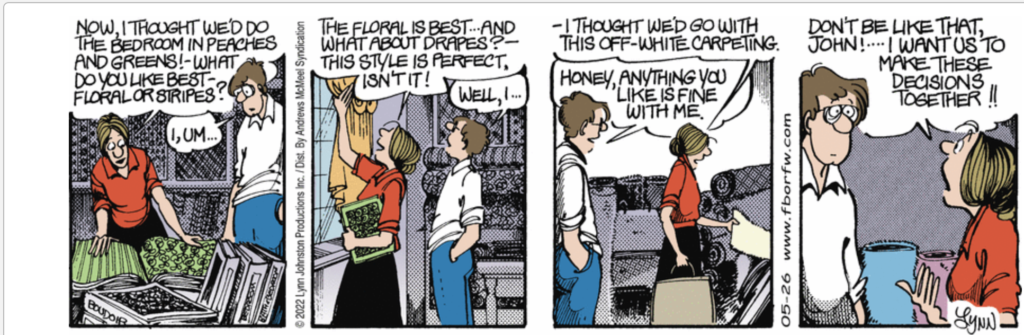
We have to have a comic, don’t we?
The Brilliant Mind of Edison Lee is a pretty good strip if you have kids, and a lot of kids say “Legos.” Incorrectly.