British and American English
It is said that one of the greatest barriers between the British and us Americans is our common language. Everybody knows about the British napkin being an American diaper, and a car’s bonnet being the car’s hood, and the WC is the bathroom. But what about longer expressions such as idioms? Some time ago I ran into a chart that compares several expressions. I don’t know the source, but if you know, or are the source, step forward and I’ll give credit. The original I got was a fuzzy jpg, so I retyped it.
In the interests of international harmony, I include it here. (Jim, maybe you could comment?)
What the British say |
What the British mean |
What others understand |
I hear what you say |
I disagree and do not want to discuss it further |
He accepts my point of view |
With the greatest respect… |
I think you are an idiot |
He is listening to me |
That’s not bad |
That’s good |
That’s poor |
That is a very brave proposal |
You are insane |
He thinks I have courage |
Quite good |
A bit disappointing |
Quite good |
I would suggest… |
Do it or be prepared to justify yourself |
Think about the idea, but do what you like |
Oh incidentally/by the way |
The primary purpose of our discussion is… |
That is not very important |
I was a bit disappointed that… |
I am annoyed that… |
It really doesn’t matter |
Very interesting |
That is clearly nonsense |
They are impressed |
I’ll bear it in mind |
I’ve forgotten it already |
They will probably do it |
I’m sure it’s my fault |
It’s your fault |
Why do they think that it was their fault? |
You must come for dinner |
It’s not an invitation; I’m just being polite |
I will get an invitation soon |
I almost agree |
I don’t agree at all |
He’s not far from agreement |
I only have a few minor comments |
Please re-write completely |
He has found a few typos |
Could we consider some other options |
I don’t like your idea |
They have not yet decided |
Subscribe to this blog's RSS feed
Who says mathematicians can’t be funny?
March 14 is Pi day. At least it is for folks who want to promulgate a love for mathematics, or show off their knowledge of this most familiar of transcendental numbers. I understand the US congress officially recognized the day, even though it isn’t a national holiday.
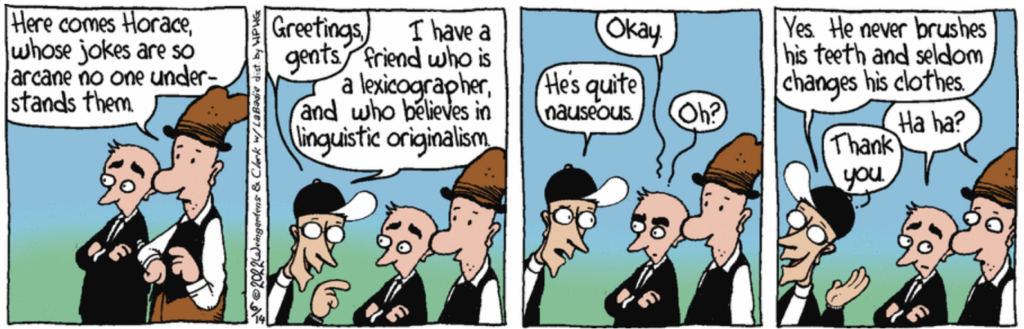
Mathematical humor is usually seriously flawed, though. For one thing, the more arcane your knowledge of math, the funnier the jokes are. This usually means you have to delve fairly deeply into arcanity. The other thing is that a lot of mathematical humor is based on puns, the proper response to which is a groan.
Having apologized in advance, I now present a few samples of mathematical humor from a site that trades in this low art. Since the site concentrates on the math, the actual artistry is pretty primitive—the characters are striped triangles with circular heads. They represent humans, er, mathematicians of different stripes. The site is called Spiked Math.
(ahem) Well, yes. Pretty good pun. Pi day’s post on that site has two more, so go take a look. The strip for March 12 is certainly thought provoking, and you can get a lot out of it with mere high school algebra. An earlier date has another strip on the subject of Pi Day. Go check the place out. I warn you, though. The more math you know, the funnier Spiked Math is.
Got any math jokes you want to share?
As you like
(My apologies to Shakespeare for the title of this post; at least it’s grammatical.) I had planned another serious lesson for today, but this comic popped up. It mentions a grammatical issue I’ve been wanting to mention for a long time, correct use of “like” and “as.”
It’s not hard, really. We use both words for comparisons. Remember that “like” is a preposition, so it goes with nouns and pronouns. The trick is that with “as,” which is an adverb, we often leave out the verb, and all you see is a nearby noun. Perhaps you remember the book Black Like Me. The grammar of the title is correct. If you wanted “as” in that phrase, you’d have to say “Black as I.” Where’s the verb? It’s implied. You’re really saying “Black as I am.”
So maybe this is part of The Hard Part of Writing—you have to think about what you’re writing. Are you comparing a noun or a verb? Test by seeing if you can insert a verb into your sentence.
All that to get to the comic:
Regular readers of this site might recall that I am a fan of Brooke McEldowney, who writes and draws two erudite comics. The one above is 9 Chickweed Lane, and the other is Pibgorn. I recommend them both.
Grammar jokes
I just realized that I don’t have a post ready today, so here’s a quickie that I found on Google+. I hate to not be faithful to the three people who visit the site. Besides I posted a bar joke or two a couple posts back.
My first link to a video
I’m finding so much good material out there about language, it’s tempting to spend too much time merely sharing links. I have to discipline myself to include my own material sometimes. I was disciplined last post, and I will be again the post after next. Meanwhile, here’s a pretty good link to share.
This video is of comedian John Branyan telling the story of the three little pigs in the elevated and erudite language of a couple centuries ago. By the way, Shakespeare spoke Elizabethan English, not Old English. Click here to see it: Three Little Pigs.